The Architecture of Thresholds — Spaces That Prepare the Eye
Before it becomes a boundary, the threshold is a way of setting the scene. It slows the act of entering, filters the light, and introduces a subtle distance between two neighbouring atmospheres. In certain contemporary interiors, it no longer simply separates spaces: it gives them rhythm.
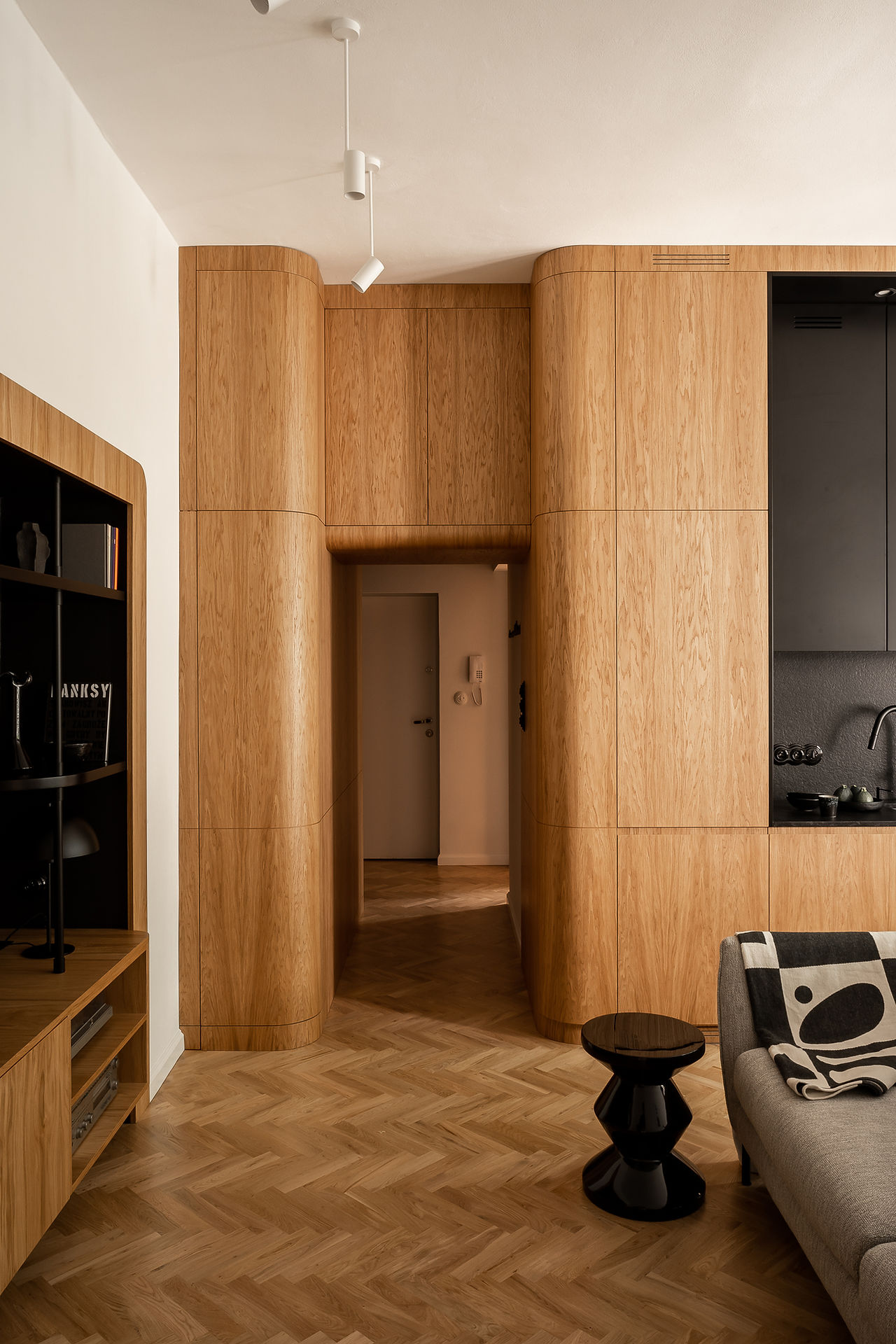
Curved joinery condenses the passage: the threshold becomes volume, envelope and interior rhythm.
Noi Studio
The Space Before the Space
We often think of architecture through its volumes, its light, its materials, sometimes even through the furniture that inhabits it. More rarely do we consider what comes before. And yet, what gives an interior its precision does not always lie within the room itself, but in the way it is approached.
A recessed entrance, a deep reveal, a step, a darkened corridor, a curtain, a partially concealed door: these elements do more than organise a place. They prepare its perception.
A threshold is not merely a line of separation. Within the architecture of thresholds, it becomes thickness, transition, a slight displacement of the gaze. It delays the space just enough to restore its presence.
In the most sensitive interiors, nothing is revealed all at once. Architecture allows for an approach. It introduces progression. It gives space time to appear.

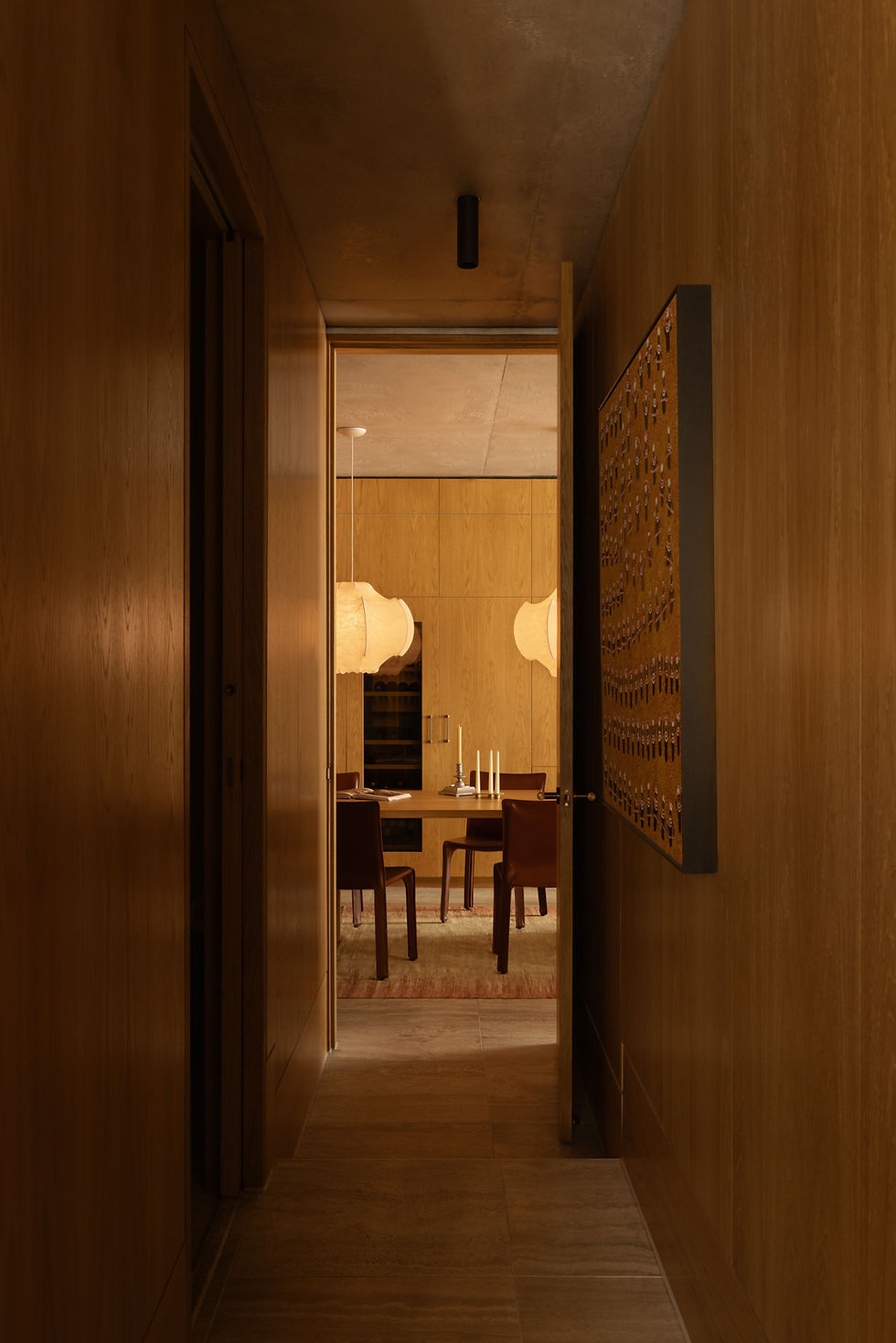
A corridor of wood and filtered light: the space is approached before it is revealed.
Guilherme Torres
The Threshold as Thickness
A well-composed threshold does not simply mark the passage from one room to another. It creates an in-between. A zone of density where one has already left a space without having fully entered the next.
This is what makes certain projects particularly compelling. In Between Spaces by LAR+D, the intermediate zones are not treated as simple circulation areas, but as true chambers of transition. The passage is not neutral. It already sets the tone. It establishes an atmosphere, adjusts the rhythm, and prepares another quality of presence.
The threshold then ceases to be a secondary moment in architecture. It becomes an active part of its composition.
This thickness can take different forms: a darker foyer, a framed corridor, a compressed entrance, a slightly delayed opening. Each time, the aim is not to close off, but to introduce the right distance between two states of space.

The passage narrows and gains density: an architecture of thresholds conceived as thickness. 
Beneath the arch, circulation curves softly: a silent transition.
LAR + D - Hélène Lacombe
Delaying the Revelation
The most memorable spaces are not always those that offer themselves immediately. More often, they are the ones that know how to hold back.
In House of Soil, designed by Soil Studios, the threshold does not first appear as a door in the strict sense. It takes the form of a dark corridor crossed by a suspended textile veil. The light remains held behind it. The view slows before opening. The body does not cross a clear boundary; it passes through a modulation.
Here, the threshold is not only seen. It is felt.
This way of filtering the entrance is essential. It shows that transition can be more atmospheric than constructive. A fabric, a shadow, a density of material, a withheld light can sometimes create a more powerful passage than a partition.
The threshold becomes a form of suspension. It does not reveal less. It reveals more slowly.

In the half-light, a textile veil holds the space back: the threshold becomes filter and slowness.
Soil Studios
When Material Gives Weight to Passage
Conversely, some thresholds assert themselves with greater presence. In the apartment designed by Razoo in Czech Cieszyn, the passage is condensed into a large veined wooden door, almost monolithic, giving the act of crossing an immediate density.
Nothing here is spectacular in a demonstrative sense. And yet, everything lies in this concentration of matter. The height, the design of the opening, the mass of the wood, the frontal clarity of the gesture: all these elements transform a simple transition into an architectural moment.
The threshold no longer merely distributes rooms. It gives them gravity.
This is another way of slowing space. Not through filter or darkness, but through material presence. The passage acquires a consistency of its own. It ceases to be abstract.

A veined wooden door condenses the passage: material gives the threshold its density and presence. 
A through-bookcase frames the passage: the threshold is inscribed through transparency.
Razoo Design - Uklon Studio
More Discreet Thresholds
Not all thresholds assert themselves with the same clarity. Some are barely suggested. They settle into a recess, a curve, a slight offset between wall and door.
This is what can be perceived in the bathroom entrance renovated by Morineau Studio. Here, the access does not appear frontally. A curved partition holds it slightly out of direct view. The door remains visible, but never immediately given. The passage becomes an approach.
This softer restraint is valuable. It reminds us that a threshold does not need to be strongly marked in order to exist. It can remain almost silent, barely inscribed within the geometry of the place, while profoundly altering the way one enters.

Held back by a curve, the door recedes slightly: a soft, almost silent approach.
Morineau Studio
Slowing, Articulating, Giving Rhythm
For a long time, contemporary architecture valued absolute fluidity: large open volumes, visual continuity, the disappearance of separations. This openness has produced generous spaces, but sometimes ones that are too immediately legible.
The return of the threshold does not mean a return to compartmentalisation. Rather, it marks a need for gradation. A need for intimacy, rhythm, and breath. Not to close, but to articulate. Not to interrupt, but to prepare.
Perhaps this is where the architecture of thresholds regains its necessity today. In a saturated visual landscape, it restores a certain slowness to space. It prevents interiors from being resolved in a single glance.
A threshold can be a step, a curtain, a curve, a thick door, a darker corridor, a material that changes beneath the foot. It can be almost nothing, and yet entirely alter the reading of a place.

The level shifts, the space opens: a calm progression between interior and landscape. 
The passage is shaped by level and repetition: an interior sequence conceived as rhythm.
Bureau Tempo + Thom Fougere Studio - Norm Architects
Between Interior and Exterior
The threshold does not only occur between two rooms. It can also emerge at the edge between inside and outside, within that intermediate space that never fully belongs to one or the other.
A covered terrace, a patio, a courtyard, a gallery, a framed opening towards the garden: these are all devices that extend architecture without interrupting it. Here again, the threshold does not merely serve the act of crossing. It serves the act of preparation. It stages a slower transition between protected space and landscape.
This intermediate zone is particularly valuable because it escapes overly clear oppositions. It allows the interior to loosen without dissolving, and the outside to approach without overwhelming.
From this perspective, the threshold becomes less a boundary than a place of modulation. It creates a more gradual relationship to site, light, air, and the variations of the day.

A covered passage frames the landscape: the threshold becomes an intermediate space.
Norm Architects
The Rhythm of a Place
A finely judged interior does not begin in the room.
It begins before it: in the thickness of a reveal, in the restraint of a light, in a veil, in a step, in a slightly offset door, in that almost imperceptible moment when architecture stops merely organising and begins to orient perception.
The threshold does not interrupt space.
It gives it rhythm.