Metal — Constructing the Domestic
Updated: 3 days ago
Before it becomes a surface, metal is a process.
It is cut, folded, bent, welded, polished. It becomes sheet, tube, plate or section. Its form depends as much on its properties as on the tools used to shape it.
For a long time, metal belonged firmly to the industrial world: machinery, commercial kitchens, workshops, infrastructure. A material associated with strength, precision and fabrication more than with the very idea of home.
And yet, metal now occupies a singular place in contemporary interior design. Stainless steel, aluminium, brass and chrome finishes appear across furniture, kitchens, lighting and, at times, the architecture itself.
Not simply as a finish.
Behind the surface lies another way of thinking about an object: through the cut, the joint, thickness, assembly and structure.

Reflective metal sits among wood, textiles and earthy tones.
Oslo Collection — Fleur Studios (Photo: Jessie Prince)
Metal Before the Interior
A plank of wood still bears the trace of the tree it came from. Stone retains an immediate connection to the block from which it was quarried.
Metal relates differently to its origin.
In the finished object, it speaks less of a natural form than of a sequence of transformations. A sheet of steel has been rolled. A tube has been formed. A plate has been cut. A curve implies pressure; a fold, force applied at a precise point.
Fabrication remains inscribed in its geometry.
This is what sets metal apart from many materials traditionally associated with domestic space. The technical intervention that gives it form does not have to disappear. It can remain legible.
An edge reveals the thickness of a plate. A weld indicates the meeting of two elements. A joint explains how a structure holds together. Sometimes, a few bolts are enough to make the entire system visible.
The object no longer fully conceals how it was made.
This legibility naturally brings metal closer to architecture. We no longer look only at a table for its top or a chair for its silhouette, but at the way their different parts support, connect and distribute weight.
Fabrication becomes part of the design.
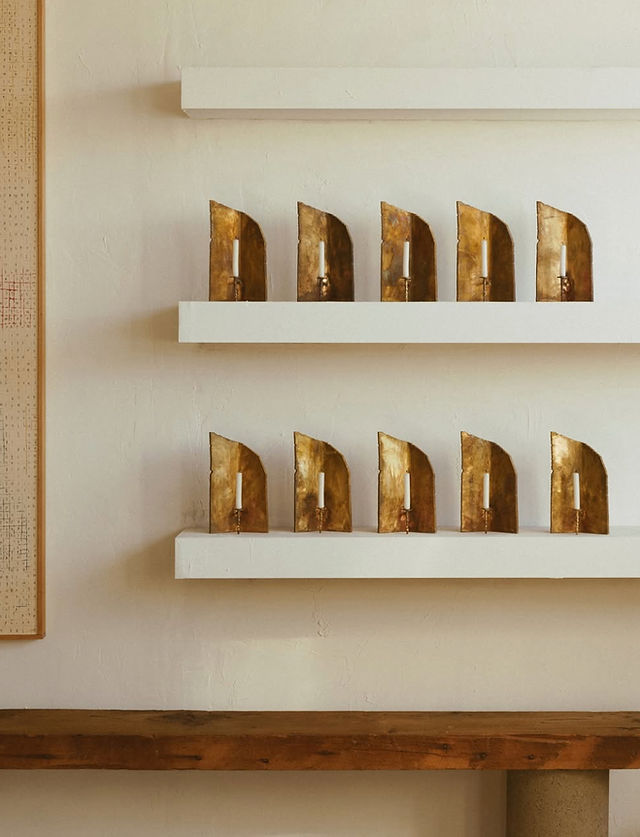
Brass reveals an irregular surface, far removed from a perfectly uniform finish. 
Broad metal planes give the armchair an almost architectural construction. 
Mirrored metal fragments the space, shifting its contours through reflection. 
At a smaller scale, the material takes on an irregular form, visibly shaped by hand.
1. Brass Candle Holder — Jeremy Le Chatelier / 2. Hublot Chair, V8 — Jeremy Le Chatelier / 3. Residential Project, Moscow — Polina Sitsman / 4. Bougeoir Artichaut — Sarah Chirazi (Photo: Amaury Laparra)
Constructing Through Assembly
Metal can produce structure with relatively little material.
A sheet is folded and gains rigidity. A tube draws a line while carrying a load. A plate can become surface, leg and structure at once. Sometimes, two joined elements are enough to define the logic of an entire object.
Here, detail is not applied after construction.
It emerges from it.
An edge, screw, joint or weld is therefore not necessarily something to hide. Its precision can become a visual quality in itself.
This is a particular way of designing: not to create the illusion that an object arrived fully formed, but to allow its assembly to remain intelligible.
This logic partly explains the affinity between metal furniture and architecture. Some elements carry. Others connect, stabilise or enclose a surface. The eye can follow the construction almost as closely as the form.
Refinement shifts.
It no longer necessarily lies in ornament or in the seamless disappearance of joints, but in the accuracy of an angle, the continuity of a fold, the proportion of a section.
A few millimetres can be enough to change the perception of a piece of furniture.
A thick plate immediately asserts its weight. A thinner sheet reveals more clearly the work required to give it rigidity. The diameter of a tube alters the visual mass of a structure. An exposed weld draws a different line from a perfectly polished joint.
With metal, every decision in the making can remain perceptible.

Polished metal introduces an almost graphic precision into an interior dominated by wood. 
The metal structure defines the armchair as much as it supports it.
1. Oslo Collection — Fleur Studios (Photo: Jessie Prince) / 2. Anti Hublot — Jeremy Le Chatelier
From Technique to Use
It would be too simple, however, to contrast industrial metal with an interior assumed to be warmer.
Domesticity is not determined by material alone. It also depends on scale, use and context.
A stainless-steel surface does not mean the same thing in a factory, a commercial kitchen or an apartment. The material may be identical; its use is not.
In the home, technique meets use.
A worktop is used again and again. A chair is moved. A handle is grasped every day. A table accumulates objects, plates, books and traces of movement.
Metal moves beyond equipment and into everyday use.
It also meets other materials.
A steel frame can carry leather. Aluminium can sit against irregular timber. A stainless-steel kitchen can coexist with old stone, a worn floor or soft textiles.
These combinations are not necessarily there to “warm up” metal. That reading too quickly reduces materials to an opposition between warm and cold.
What becomes interesting is precisely the difference between them.
Wood has grain. Textile yields. Leather stretches. Stone retains its irregularities. Metal introduces precision, continuity and, at times, sharpness, making these differences more visible.
One does not correct the other.
Their contrast shapes the space.
Domesticity then appears less as an aesthetic than as a condition of use: the point at which a material designed to resist, support or protect becomes an ordinary part of the interior.

The reflective surface transforms a tabletop object into an almost architectural volume.
Faceted Soup Tureen — Puiforcat (Photo: Julien T. Hamon)
Surface, Reflection, Weight
To speak of metal in the singular is already misleading.
Brushed stainless steel, raw aluminium, a chrome finish or unlacquered brass may share certain properties without producing the same visual experience.
Surface treatment changes almost everything.
Polished metal reflects its surroundings. The lines of a piece of furniture become less stable, crossed by the colours and movement of the room. The surface can almost disappear behind what it reflects.
Brushed steel, by contrast, diffuses light more softly. Its grain remains visible; the reflection becomes less defined, directed by the regular marks of the finish.
Metal can therefore assert itself visually or partially dissolve into its surroundings.
But surface is not enough.
Thickness matters too.
A thin folded sheet creates a very different impression from a solid plate. A tube may simply draw a structure through space, whereas a solid volume immediately asserts its weight.
This distinction between line, plane and mass allows metal to occupy space in almost opposite ways: to draw an outline without enclosing, to support without appearing heavy or, conversely, to fully assert its volume.
This is where the language of a “chrome revival” becomes particularly reductive.
It reduces metal to its shine, as though its contemporary relevance depended primarily on a reflective surface.
Yet metal is expressed as much through an edge as through a reflection, through a joint as through a finish, through a few millimetres of folded steel as through a surface entirely clad in stainless steel.
To consider it only as a finish is to overlook what it allows us to construct.

Metal structures the space through lines, shelving and supports rather than mass. 
A single metal tube is enough to define the entire silhouette of the object. 
Polished metal turns the structure into a sequence of lines and curves. 
Repeated ridges give the metal surface an almost graphic depth.
1. Friends with Frank Gertrude — Georgina Jeffries (Photo: Lillie Thompson) / 2. Sculptural Metal Tube Floor Lamp, Italy, 1960s — Modern Living / 3. Doros Side Table — Irene Khiet for Toro Manifesto / 4. Silver Set 2025 — Rachel Whiteread for Puiforcat (Photo: Eric Poitevin)
Time as a Finish
Finally, there is what the image of a newly completed interior rarely shows: what happens next.
Metal scratches, dulls and oxidises. Some surfaces become more polished where they are handled most; others retain their original state for much longer.
These transformations are not simply signs of wear. They alter the way an object is perceived.
A scratch on perfectly polished steel first appears as a break. As marks accumulate, they gradually cease to register as isolated traces. Together, they form a new surface.
Use becomes part of the finish.
Copper and certain brasses can develop a patina. Other surfaces are protected precisely to prevent or slow that transformation. Stainless steel resists corrosion, but remains susceptible to fingerprints, friction and micro-scratches.
Choosing a metal also means choosing how to live with its evolution.
Maintaining, polishing, protecting or allowing it to bear marks: each decision establishes a different relationship with time.
Resistance does not mean immutability.
This is also where the question of durability becomes more interesting than that of trend.
Not because a metal object is durable by definition. Its production, origin, treatments and construction make such a claim far too simple.
But because metal often makes the way an object has been built unusually easy to read.
Can it be dismantled? Can a part be replaced? Do its joints remain accessible? Is the structure sufficiently resolved to support different uses and multiple lives?
These questions go far beyond the choice of a finish.

A fold alone gives volume and structure to a thin sheet of metal. 
Metal frames textured glass with an almost architectural precision.
1. Stratus Lamp — Schneid Studio, 2024 / 2. Panthéon — Rudy Guénaire (Photo: Ludovic Balay)
Another Idea of the Domestic
Metal has probably never truly left our interiors.
What has changed more significantly is the way we choose to see it.
No longer simply as a technical material to conceal, nor as a reflective surface to emphasise, but as a set of properties capable of contributing directly to the design of an object or a space.
A plate can carry. A fold can create rigidity. A joint can remain visible. A surface can reflect or register the marks of use.
Within domestic space, this logic of construction does not disappear.
It changes scale and function.
Perhaps this is where metal’s lasting relevance lies: not in the periodic return of a particular finish, but in what it makes visible about fabrication itself — how an object holds together, how it is assembled, how it is used and how it ages.