
Faye Toogood — The Object as Relic
In Faye Toogood’s work, objects seem to arrive in the present with a history already inscribed within them. Wood retains its grain, stone reveals its fossils, while forms evoke fragments whose origins remain elusive. Not old objects, but objects designed to outlast their own newness.
A new object should not yet carry any memory.
No wear, no handling, no story. In Faye Toogood’s work, this neutrality is rare. A cavity cuts into a mass of wood. Openings interrupt a tabletop. One volume curves as though it had been slowly transformed by touch; another appears to have yielded under its own weight.
The function remains legible — a table, a chair, a console — but it is not enough to explain what we are looking at.
The British designer’s pieces do not reproduce any specific artefact. Yet they carry something of the artefact: a presence difficult to date, the sense of a form recovered rather than newly drawn.
At the boundary between furniture and sculpture, Faye Toogood’s practice draws on the forms and materials of the English countryside: gnarled trees, standing stones, landforms and natural fragments. Yet this proximity is not based on a literal imitation of nature. It raises a deeper question: how can a sense of duration be inscribed within an object before it has even been used?

Butter Sofa - soft volumes that seem to yield under their own weight.
Butter Sofa, Tacchini - Design: Faye Toogood. Image: Tacchini and Faye Toogood Studio.
A Form Recovered
In Faye Toogood’s work, creation often begins with a feeling of recognition.
A piece might recall a bone, a pebble, a burial mound, a tool or a fragment of architecture. Yet it never corresponds entirely to any one of them. References overlap, then recede. The eye believes it has identified an origin before losing it again.
This indeterminacy distances the object from a simple exercise in style. The form does not merely seek to be sculptural or expressive. It seems to emerge from a vocabulary older than that of contemporary furniture.
Its solid masses, hollows and elemental supports could belong as readily to the landscape as to the domestic interior.
In Assemblage 7: Lost and Found, this relationship becomes particularly visible. Works named Plot, Barrow, Cairn, Hill, Hoard or Lode borrow their language from the earth, the terrain, burial and what remains out of sight.
The pieces are first modelled in clay before being translated into wood and stone. The materials are then hollowed, carved and shaped through subtraction, until volumes emerge that seem to have been drawn from the material rather than imposed upon it.
The finished object retains something of this tactile origin. The precision of its making erases neither the initial modelling nor the impression that the form existed before the gesture that revealed it.
Making becomes a form of searching: not for an object literally concealed within a block, but for the sensation that it might have been there all along.

Assemblage 7: Lost and Found II - the form first emerges in clay. 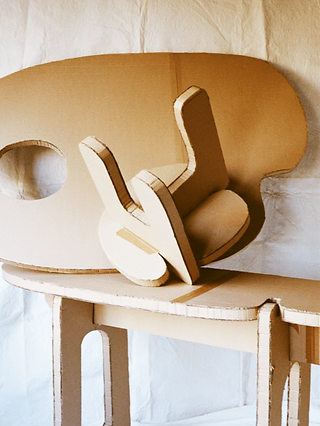
Palette Side Table, prototype - the design takes shape in cardboard. 
Roly Poly Chair - a hollowed seat resting on four substantial legs. 
Assemblage 7: Lost and Found II - from clay to carved wood.
1. Assemblage 7: Lost and Found II - Design: Faye Toogood. Photography: Genevieve Lutkin. / 2. Palette Side Table, prototype - Design: Faye Toogood. Image: Faye Toogood Studio. / 3. Roly Poly Chair - Design: Faye Toogood. Image: Faye Toogood Studio. / 4. Assemblage 7: Lost and Found II - Design: Faye Toogood. Photography: Genevieve Lutkin.
Material as Duration
This sense of discovery does not rest on silhouette alone. It also emerges through the materials chosen to carry it.
In Lost and Found, Faye Toogood works with English oak and Purbeck Marble — not a marble in the geological sense, but a dense, fossiliferous limestone quarried in Dorset. Once cut and polished, the stone reveals traces of shells formed long before its extraction.
These materials do not simply bring texture or colour to the pieces. They introduce timescales that extend far beyond the project itself.
In the wood, the grain travels through the volume without fully submitting to it. In the stone, fossils interrupt the continuity of the surface. Each block contains variations that precede its transformation and remain visible afterwards.
Material is never a blank page upon which the design is inscribed.
Toogood has compared her work on this series to an archaeological excavation: the block becomes a landscape to be explored, within which the form is gradually discovered. The gesture is less about covering than revealing; less about adding than removing.
This image might suggest a process guided by chance or by the accidents of the material alone. Yet the result is precisely constructed. The hollows, rough surfaces and transitions towards smoother areas are carefully worked to preserve several states within the same object: the block and the piece, natural density and the maker’s hand, the transformed surface and what it continues to reveal of its origin.
The object remains contemporary, but it does not begin entirely at the moment of its production. It also carries the time of the tree, of geological formation, of extraction and of the hand that shaped it.
Material does not merely realise the form. It lends it an age.

Dough Stoneware - utilitarian forms with almost organic volumes. 
Puffy Lounge Chair - the upholstery spills beyond an exposed structure. 
Butter Armchair - an enveloping seat conceived as a soft mass.
1. Dough Stoneware - Design: Faye Toogood. / 2. Puffy Lounge Chair, Hem - Design: Faye Toogood. / 3. Butter Armchair, Tacchini - Design: Faye Toogood. Image: Tacchini and Faye Toogood Studio.
Beyond Newness
Unveiled in July 2026, the Bone, Roll, Slump collection extends this line of thought into a more directly domestic register. Three families of furniture explore distinct states of form: what remains, what movement softens and what yields to weight.
In Bone, tables and chairs evoke the skeleton, the fossil and the fragment preserved after the disappearance of everything else. Carved from solid oak, the table is punctured by four circular openings. These reveal the vertical grain of the wood while recalling the oversized dowels used in traditional joinery.
The reference is never reproduced literally. It remains present as a trace: in the thickness of the tabletop, in the rounded legs, in the almost anatomical presence of the volumes.
With Roll, the angles disappear. Consoles and bedside tables take the form of oblong masses whose grain follows the curve. The silhouettes seem less to have been shaped by a decisive cut than gradually softened, as though exposed to the repeated passage of an external force.
Soft Slump introduces another relationship with the body. Fabric is gathered and tightened around a soft volume, forming deep folds. The material appears to relax, collapse and find its balance under the force of gravity.
The three families therefore describe more than forms. They suggest transformations: the structure that remains, the volume that becomes rounded, the surface that gives way.
Yet these objects are neither ruins nor sculptures artificially made usable. They remain entirely intended for everyday life. The body sits upon them, hands follow their contours, and movement alters their position within a space.
Use does not interrupt their story. It continues it.
As newness recedes, the marks of actual use can meet those the form seemed already to contain. A patina emerges, fabric loosens, a surface retains the trace of contact. The object is no longer considered solely at the moment it leaves the studio, but in light of what it will become.

Soft Slump Armchair - fabric relaxes around a volume set on industrial castors. 
Roll Nightstand - the grain follows the softened curve of the form.
1. Soft Slump Armchair - Design: Faye Toogood. Image: Faye Toogood Studio. / 2. Roll Nightstand - Design: Faye Toogood. Image: Faye Toogood Studio.
What Remains
Faye Toogood’s work seeks neither to reconstruct the past nor to manufacture imaginary antiques.
Here, the relic refers less to a particular era than to a condition of the object: its ability to retain something of what preceded it, while remaining open to what will come after.
A mass recalls a landform, a bone or a fragment without ever being reduced to that resemblance. A stone exposes a geological duration that exceeds that of the project. The grain of the wood continues to exist beyond the silhouette it has been given.
Within a design culture largely organised around launches, new imagery and immediate recognition, Faye Toogood shifts the perspective. She considers the object across an expanded timescale: before its making, through the gestures and materials that bring it into being; then beyond its newness, when its original context begins to recede.
The object becomes a relic not because it belongs to the past, but because it is designed to preserve a presence once the present has withdrawn.


