
Ephemeral Architecture — Constructing the Fashion Show
Built for a Few Minutes
A fashion show lasts only a few minutes. Yet the spaces created to host it can require weeks of design, fabrication and installation. Built to be traversed only once, they are inhabited for the duration of a presentation, then transformed or dismantled almost immediately. This disproportion between the effort involved and the brevity of the experience is one of contemporary fashion’s most striking paradoxes.
Fashion houses now occupy existing buildings, repurpose industrial sites, move through landscapes or construct entirely temporary environments. The show no longer simply unfolds before a backdrop. It organises volumes, defines routes, calibrates distances and changes the way silhouettes appear.
Not every scenography, however, constitutes architecture. The term becomes relevant when space moves beyond its role as a background and begins to act upon bodies, circulation and perception. A straight line, a circular setting or a sequence of rooms will never produce the same reading of a collection.
Architecture determines what is revealed immediately, what remains outside the frame and how the gaze moves.
Freed from the need to last, the ephemeral architecture of the fashion show can experiment more freely. It embraces instability, movement, illusion and sudden transformation. For a few minutes, it becomes a full-scale laboratory in which fashion tests new relationships between the garment, the body and space.
The purpose, then, is not to assemble a succession of spectacular sets, but to understand what these architectures do to the fashion show. How do they direct movement and the gaze? How do they transform the perception of the clothes? And what remains of these spaces once the presentation is over?

The veils turn the walk into a succession of appearances.
Balmain — Autumn/Winter 2026
From the Runway to a Spatial Framework
In its most elementary form, the runway serves a precise function: to make the clothes visible. A linear route guides the models past an audience seated on either side. The repetition of the walk allows each silhouette to be observed in turn, from a relatively consistent distance and viewpoint.
Even this apparently neutral arrangement already shapes the way a collection is revealed. The length and width of the route, the proximity of the front row and the pace of the walk all alter the perception of volume. The runway orders bodies and constructs a sequence. It turns a collection of garments into a succession of appearances: each silhouette exists for a few moments before giving way to the next.
As fashion shows have moved away from this conventional model, space has ceased to be a mere support. It has become an active part of the presentation. A fashion house may inhabit an existing building and reveal its proportions, repurpose a warehouse, follow the topography of a landscape or create a setting with no function beyond the show itself.
Each configuration produces a different experience. A linear route keeps attention focused on the progression of the silhouettes. A circular arrangement multiplies viewpoints and may blur the distinction between beginning and end. A sequence of rooms fragments perception: rather than encountering the collection as a whole, the spectator experiences a series of partial appearances. Conversely, a wide-open space can place the clothes within a monumental frame, making the bodies appear almost vulnerable in relation to their surroundings.
Working within existing architecture adds another layer of meaning. A palace, a gallery, a garden or a piece of abandoned infrastructure is never simply a container. Its history, materials and former uses remain present alongside the clothes, sometimes through continuity, sometimes through contrast. The collection may extend the character of the setting, resist it or temporarily alter its function.
When built from scratch, the setting offers a different kind of freedom. It can establish its own scale, conceal its boundaries, alter relationships of height or create routes that would be impossible within a conventional venue. Space and presentation are then conceived as a single gesture.
The transition from runway to spatial framework is therefore not simply driven by escalating means or the pursuit of spectacle. It represents a change of function. Space no longer merely displays the clothes: it participates in their appearance and structures their relationship with the audience.
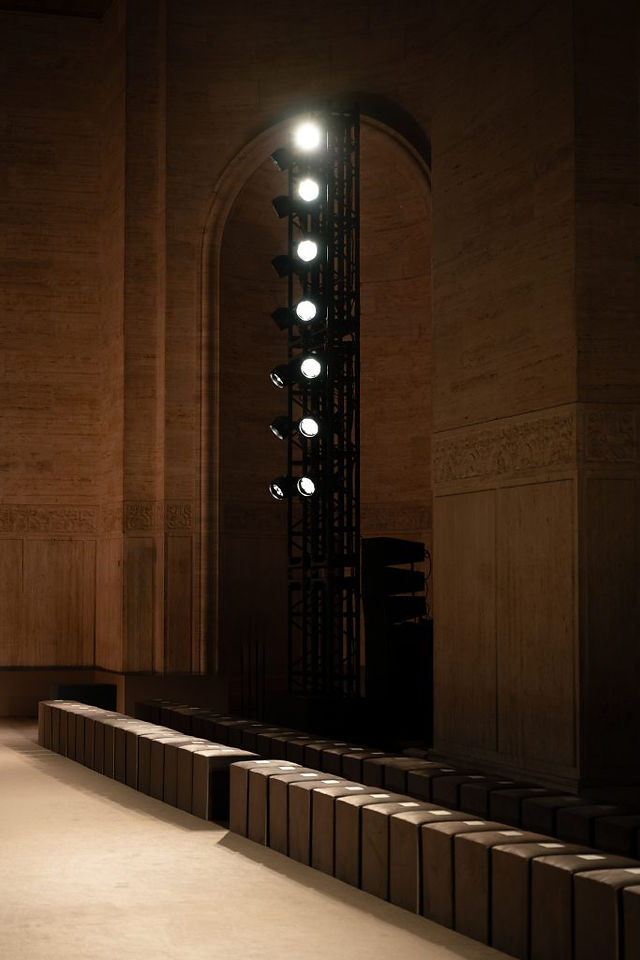
The temporary installation redraws the existing architecture. 
Shadow, light and framing reduce the space to an apparition.
1. Coach — Autumn 2026, Cunard Building (photo: Isidore Montag/BFA) / 2. Saint Laurent Men’s — Winter 2026, Bourse de Commerce (photo: Saint Laurent)
Choreographing Bodies and the Gaze
A fashion show does more than present clothes. It orchestrates their appearance.
The route imposes direction, speed and sometimes even an attitude. A straight line extends the duration of the walk. A turn interrupts its continuity and may slow its rhythm. A wall conceals a silhouette before revealing it, while an open space leaves it visible long before it reaches the audience. Architecture turns each passage into a sequence.
It also shapes the way bodies relate to one another. Models may walk alone, cross paths, follow closely behind one another or appear simultaneously at several points within the space. Depending on the arrangement, the collection can be read as a precise succession or as a more diffuse whole, with several silhouettes coexisting within the field of vision.
Distance plays an equally decisive role. At close range, the garment reveals itself through its details: a seam, the movement of a fabric, the way a material responds to each step. From further away, the silhouette becomes a form within space. Its volume, proportions and relationship with the setting take precedence over its construction.
Architecture also choreographs the audience’s gaze. Facing a conventional runway, the viewer follows a predictable trajectory. When seated around a circle, at the centre of an installation or along a fragmented route, the viewer must instead decide where to look. The head turns, anticipates an appearance and sometimes loses sight of a silhouette before encountering it again from another angle.
This instability changes the nature of attention. Everything can no longer be seen at once or from an ideal viewpoint. The viewer is not given a complete image, but constructs a personal reading from fragments, juxtapositions and absences.
The fashion show then becomes a shared choreography. Models move through the space; the gaze moves with them. Architecture determines not only what is visible, but how a silhouette arrives, how long it remains present and what lingers after it disappears.

The scale of the setting transforms the arrival into an architectural sequence. 
The curved route delays the silhouette’s appearance. 
The walls stage a gradual appearance through material and depth. 
Light gives the veils an almost architectural presence.
1. Jacquemus — Le Paysan, Spring/Summer 2026 (photo: Jacquemus) / 2. Hermès Women’s — Autumn/Winter 2025 (photo: Filippo Fior) / 3. Hermès Women’s — Autumn/Winter 2025 (photo: Larissa Hoffmann) / 4. Balmain — Autumn/Winter 2026 (photo: Valerio Mezzanotti)
When Space Becomes Atmosphere
The architecture of a fashion show is not always defined by what is built. It can also emerge from what surrounds the bodies.
Diffuse light dissolves the outlines. Near-total darkness slows the appearance of the silhouettes. Fog compresses the depth of field, while a continuous sound seems to alter the perception of time. Without moving a wall or erecting a structure, these elements already transform the experience of the setting.
They also act upon the clothes. A reflective material reads differently under direct light than in shifting half-light. A lightweight fabric takes on a different presence when caught by the wind. Water, heat or humidity can reveal a weight, movement or fragility that a conventional runway would leave almost invisible.
Atmosphere is therefore not an addition layered onto architecture. At times, it becomes its principal material. A space can feel larger, more intimate or more unstable depending on how it is lit, shaped by sound or crossed by a passing phenomenon.
This sensory dimension acts directly upon the audience. Cold, vibration, unusual proximity or prolonged silence engage the body before the eye can begin to analyse the scene. The spectator no longer simply observes an environment but experiences its conditions.
The collection then takes on a tone that extends beyond appearance alone. Calm can emphasise the restraint of a silhouette. A more charged atmosphere may reveal its rigidity or vulnerability. The setting does not necessarily tell a specific story; instead, it establishes a state in which the clothes are received.
Here, ephemeral architecture reaches its most immaterial form. It no longer simply organises volumes or circulation. It creates a sensation—one that may be difficult to photograph, yet remains essential to the experience of the fashion show. For a few minutes, space becomes less an object than a climate.

The blur captures less the garment itself than the sensation of its passing.
Saint Laurent Women’s — Winter 2026 (photo: Amedeo Bellini)
Building Without Permanence
Knowing that the setting will disappear profoundly changes the way it is conceived.
Permanent architecture is generally designed to endure, accommodate repeated uses and exist over time. Fashion-show architecture can be conceived around a single moment. It may need to stand for only a few hours—long enough to receive the audience, accompany the silhouettes and produce the intended experience.
This brief lifespan opens up a particular field of experimentation. A structure may move, deform or disappear during the presentation. A volume may suddenly open, a floor become unstable or a material be selected for its fragility rather than its resistance. What would be difficult to sustain within a building becomes possible in an environment designed for a single use.
The fashion show then operates as a full-scale prototype. It allows relationships to be tested between a body and a surface, light and material, movement and structure. Rather than serving as a model to be reproduced, the space becomes a temporary hypothesis: what happens when a silhouette crosses a reflective floor, disappears behind a membrane or seems constrained by the proportions of its surroundings?
Yet this freedom comes with its own limits. The more assertive the scenography becomes, the more it risks diverting attention. The garment may become one element within a larger image, reduced to a form inside an environment designed to be immediately memorable.
Brevity also creates a material contradiction. Building to disappear requires surfaces, structures, energy and labour for an extremely short period of use. The question therefore lies not only in how long the installation remains visible, but in what precedes and follows it: where the materials come from and whether they are reused, transformed or discarded.
Ephemerality is neither inherently liberating nor inherently irresponsible. Everything depends on what this brevity makes possible and how it is organised. It can encourage excess, but it can also enable an economy of means, the reuse of existing elements or the creation of an exceptionally precise spatial gesture.
Building without permanence does not mean building without consequence. The intensity of an experience must also be measured against what it requires, what it transforms and what it leaves behind.

The repetition of light turns the passage into an enduring image. 
A single line of light is enough to construct the frame. 
Light extends the silhouette into an almost motionless image.
1. Saint Laurent Men’s — Winter 2025 (photo: Saint Laurent) / 2. Tom Ford — Spring/Summer 2026 (photo: Tom Ford) / 3. Saint Laurent Women’s — Winter 2025 (photo: Saint Laurent)
Architecture Designed for the Image
The contemporary fashion show no longer addresses only those in attendance. It is also conceived for a second, often far larger audience, who will encounter the space only through photographs, films or a few seconds of footage shared online.
This dual audience reshapes the scenography. The setting must work from the seats, but also through the lens of a camera. A perspective may be composed for a frontal view; a form may become fully legible only from above, while repeated lines or silhouettes can create an instantly recognisable image.
Architecture therefore organises framing as much as circulation. It stages appearances, composes backgrounds and establishes relationships of scale that remain legible when reduced to a screen. Certain spatial gestures carry an immediate graphic force: a uniform surface, a pronounced contrast, an oversized structure or a sudden transformation may condense the entire experience into a single image.
Yet this legibility is never complete. A photograph fixes one perspective and isolates a single moment. It cannot convey the duration of the walk, the movement of the gaze or the sensation of being enclosed or overwhelmed by a volume. Sound, temperature, the proximity of bodies and the true depth of the setting remain partly outside the frame.
Lived space and represented space never entirely coincide. A restrained setting may produce an intense physical experience while leaving little visual trace. Conversely, a scenography structured around an immediately recognisable gesture may acquire new power once removed from its original context.
The circulation of images considerably extends the life of the fashion show. What existed for only a few hours may be viewed, shared and archived for years. The architecture disappears, yet some of its angles, proportions and phenomena continue to shape the memory of a collection.
A final paradox emerges: the more temporary these spaces are, the more their design may be shaped by what will outlast them. The fashion show takes physical form, yet often endures as an image.

The monogram becomes a route, multiplying viewpoints.
Chanel Haute Couture — Spring/Summer 2025 (photo: Chanel)
What Remains After It Disappears
The fashion show constructs a space designed to disappear. Yet this brevity does not necessarily diminish its impact. It can instead concentrate the architecture around a precise gesture: directing a walk, altering a distance, unsettling perception or giving a collection a particular presence.
The most compelling settings are not always the most monumental. Their strength lies less in the scale of the resources involved than in the relationship they establish between the space, the bodies, the clothes and the gaze. When scenography succeeds, it does not distract from the collection. It creates the conditions in which the clothes can appear differently.
Ephemeral architecture enables experimentation while revealing its own limits. It creates an intense physical experience, even though most people will encounter the show only through images. It disappears quickly, even as it sometimes seeks to leave a lasting trace.
Perhaps the singularity of fashion-show architecture lies precisely in this tension. Unlike a building, it does not seek to organise life over time, but to transform, for a time, the way a body moves through space and a garment becomes visible within it.
Once the structures have been dismantled, the setting itself rarely remains. What persists instead is a sensation, a movement, a proportion or an image. For a few minutes, architecture shifts the gaze. Sometimes, that is enough to change the way a collection is remembered.


