
The Gallery as Interior — Another Way of Exhibiting
Updated: Apr 14
The gallery as interior is not a typology, but a shift in position. Some spaces do not present art.
They receive it.
Without clear signals, without frontality. Objects are not displayed, but held - within a slower, more diffuse, almost domestic relationship.
The gallery then ceases to be a place of exhibition.
It becomes an interior: not to reveal, but to contain.
A space where distance is set differently, where light does not illuminate but accompanies, where architecture does not impose but establishes a way of being.
Across different geographies, certain galleries move away from the logic of display to offer something else: no longer places of observation, but environments to inhabit - through the gaze, through the body, through time.
In this approach, the gallery is no longer conceived as a place of display, but as an interior - where space no longer seeks to show, but to establish a relationship.

Wooden counter and low-hanging pendants in Tage Gallery, with a partition inspired by Japanese panel
Photo: Tage Gallery
Milván Gallery — Inhabiting space
At Milván Gallery, in Copenhagen, nothing appears truly on display.
Objects are not arranged to be seen, but to exist within a space of their own: one that feels closer to a room than to an exhibition setting.
Distances are short. Surfaces (often matte) absorb light rather than reflect it. Volumes remain at a human scale.
There is no rupture between object and environment. No plinth, no explicit device. Only a quiet continuity.
The gaze follows no prescribed path.
It lingers, moves closer, shifts slowly: like within an interior.
Here, the gallery does not frame.
It settles.

Wooden coffee table with open niches, used to hold objects and books. 
Stone sculpture lit by grazing light, placed on a simple plinth. 
Wood and leather armchair with angular lines, set within a space defined by textured walls. 
Wooden table on mineral supports, paired with a woven chair and a lamp.
Photos: Milván Gallery
Tage Gallery — Space in withdrawal
Where Milván establishes continuity, Tage Gallery pushes withdrawal further still.
In Copenhagen, space almost disappears.
Light, often lateral, becomes the first structure of the space.
It slides along walls, softens edges, and allows objects to emerge without ever fully isolating them.
Nothing is underlined.
Nothing is accentuated.
Elements seem held at a distance: not removed, but suspended within a precise interval.
Emptiness operates less as absence than as a quiet tension between things.
Walls do not impose a reading.
They accompany.
The gallery becomes a space of deceleration: a place where perception shifts, where attention narrows.

Ceramic piece set within a dark wood niche, with controlled light and a matte backdrop. 
Furniture, chair and painting compose a domestic setting within Tage Gallery, Copenhagen. 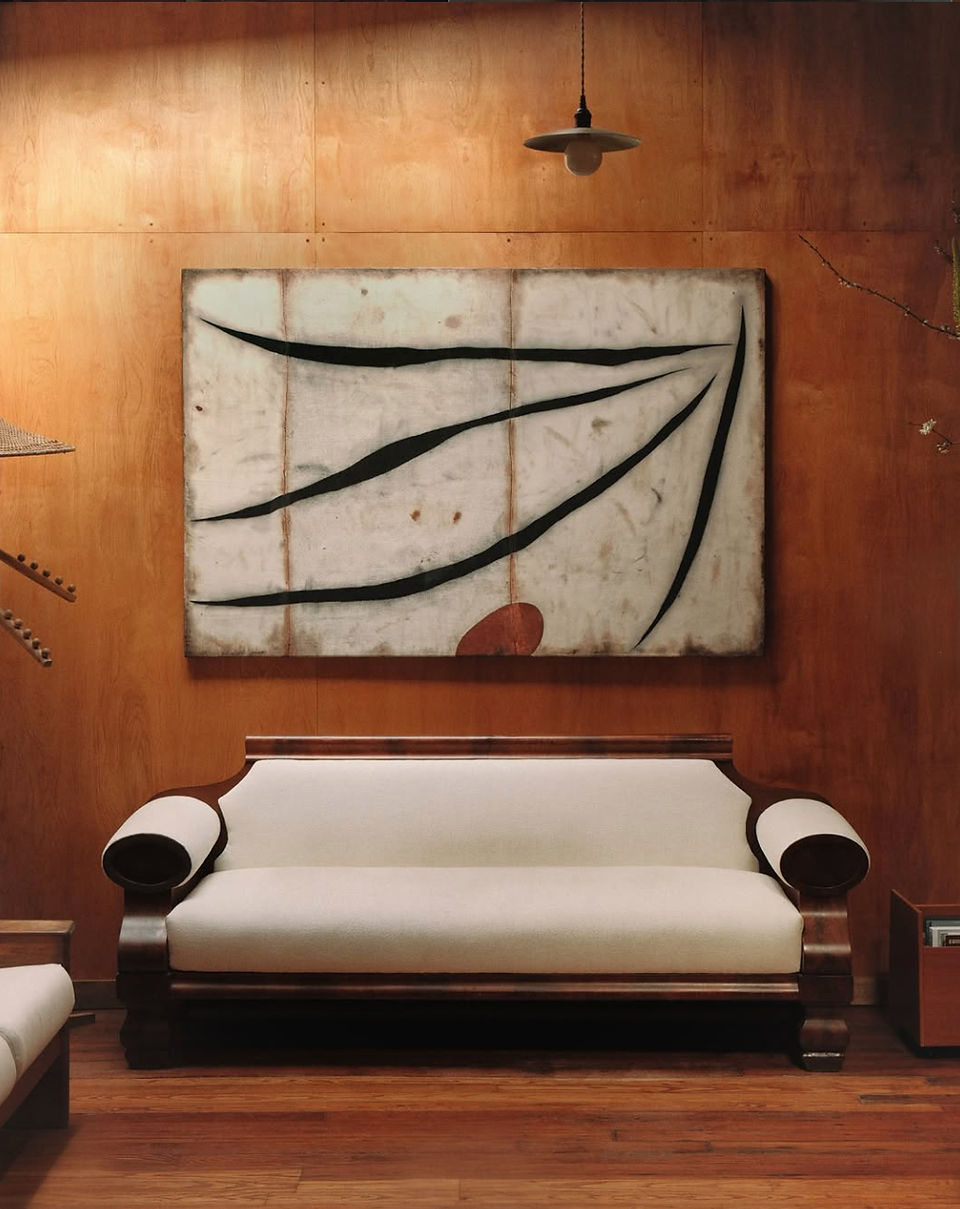
Sofa and wall piece placed within a wood-lined space, defined by calm proportions. 
Overall view with table, furniture and natural light within Tage Gallery, Copenhagen.
Photos: Tage Gallery
Objective Gallery — Constructing space
With Objective Gallery, in Shanghai, space regains a more assertive presence.
Where Tage withdraws, Objective organises.
Volumes are more defined, thresholds more legible, transitions more explicit.
Architecture does not disappear, it structures.
Objects do not dissolve into the space; they are inscribed within it with precision - sometimes isolated, often held at a distance.
Each piece occupies an exact position, as if held within an invisible grid.
Emptiness is no longer a retreat.
It becomes a compositional tool.
The gallery no longer evokes a room.
It asserts a construction.

Solid wood assembly punctuated by a charred element, revealing the making process. 
Mirror and wooden seat with organic forms, between furniture and sculpture. 
Wooden objects with free forms, revealed through lateral light. 
Solid wood lamp extended by a textured shade.
Photos: Objective Gallery
Towards another way of exhibiting
In these spaces, exhibition no longer relies on visibility. It relies on relationship.
Art is not simply shown. It is contained, accompanied, sometimes even held back.
The gallery is no longer something to move through.
It unfolds as an interior: in fragments, through movement, through successive adjustments of the gaze.
The gallery as interior is no longer defined by what it shows, but by how it holds things - within a distance, a light, a duration.
Perhaps the shift lies here: moving from a logic of presentation to a logic of position.
No longer seeing the work, but finding one’s place in relation to it.
Spaces that do not seek to be seen, but to be inhabited, slowly.


